
Loma Linda Public Records Coverage
Each Loma Linda record set follows its own access rule. City Hall keeps municipal actions and local permit files, but it is not the custodian for police reports or vital certificates. San Bernardino County Assessor-Recorder-County Clerk, known as ARC, keeps the recorder index, parcel data, county-clerk filings, and vital-copy services. The Superior Court controls court files. This coverage table separates an online search from access to the underlying document.
| Loma Linda record set | Responsible custodian | Online starting point | Access route |
|---|---|---|---|
| City actions, permits, and administrative files | City Clerk or responsible city department | City pages, permit portal, PRA form | Online record, city request, or counter |
| Deeds, liens, maps, and recorded documents | San Bernardino County ARC Recorder-Clerk | ARC Public Access index | Free index; copies online, by mail, or in person |
| Owners, parcels, and mailing addresses | San Bernardino County ARC Assessor | govPIMS | Free public parcel application; protected data withheld |
| Civil, criminal, family, probate, traffic, and small claims | San Bernardino Superior Court | Court Access Portal | Public index and allowed remote documents; clerk fallback |
| Birth, death, and marriage certificates | ARC, county Public Health, or CDPH | Copy-service pages, not an open recent-person index | Authorized or informational copies under California law |
| Sheriff reports and current jail data | San Bernardino County Sheriff's Department | NextRequest and Inmate Locator | Locator is public; report access may be limited |
California's Public Records Act opens agency records unless a statute or exemption applies. It does not override rules for sealed cases, confidential family documents, protected voter data, recent vital certificates, or restricted law-enforcement material. A portal result may identify a file without making every page available. That difference is central to Loma Linda public records access.
Loma Linda Recorder Records Index
The ARC Public Access System indexes recorded documents by party name, document number, document date, and document title. A grantor transfers an interest; a grantee receives it. Name spelling matters, and ARC recommends trying spelling variations. The portal requires acceptance of its disclaimer and may present a session or CAPTCHA step.
| Recorder search field | Input type | Required? | Research-based use note |
|---|---|---|---|
| Grantor, grantee, or party name | Text | Depends on mode | Try all known spelling forms |
| Document number | Text | Optional | Direct route when a number is known |
| Document or recording date | Date or range | Optional | Narrows results by time |
| Document title or type | Text or dropdown | Optional | The live type list was not captured |
| I Accept | Button | Yes | Opens the portal after the disclaimer |
ARC's property-research page describes the grantor-grantee index as covering 1958 to the present. Its official-records page separately labels Document Search as 1925 to the present. Those statements refer to related but differently described access paths. Pre-1958 chain-of-title work uses microfilm by decade at the main Recorder office. Keep both published limits in mind instead of assuming one clean start year.
Why Loma Linda Records Stop at Index
The recorder portal works like a card catalog, not an image vault. Its result identifies the parties, title, date, and document number. Public users cannot open the recorded image online. Once the right entry is found, ARC offers an online copy order, a mail request, and office viewing at the Hall of Records or High Desert Government Center. Appointments are strongly encouraged and prioritized. Map copies are sold only at the San Bernardino Hall of Records.
ARC lists copy fees effective July 1, 2026 as $4 for the first page, $1.50 for each later page, and $1.50 per page for a certificate under seal. Online card payments carry a 3.5% surcharge. Non-certified copies may be emailed, while certified copies ship to the provided address. Mail requests use a copy form, check or money order, and normally return within one to two weeks after receipt.
- Index
- A list that points to a recorded document but does not display its full text.
- Image
- The scanned or reproduced pages of the actual recorded document.
- Certified copy
- A copy authenticated by the custodian for an official purpose.
- Custodian
- The office responsible for keeping and releasing a record.
- Exemption
- A legal basis for withholding all or part of an otherwise requested file.
Note: A recorder-index hit confirms an indexed filing, not the present truth of every statement inside that filing.
Loma Linda Property Records and GIS
The recorder cannot find ownership by street address. Use govPIMS assessor property information first. It accepts parcel number, address, street, city, ZIP code, and owner-name inputs. Its parcel report may show current owners, ownership shares, acquisition and document data, situs and mailing addresses, legal description, parcel and owner history, roll values, and property characteristics. A situs address is the physical site. The mailing address is where assessment mail goes, so the two can differ.
The useful records flow is short: address to govPIMS parcel, parcel to owner and legal description, owner to recorder grantor-grantee index, then document number to a copy request. The legal description identifies land by tract, lot, subdivision, or another survey system. It is not the street address or assessor parcel number. Protected addresses may appear with a Government Code section 7928.200 notice rather than an exposed home address.
City and county GIS layers help confirm whether land lies inside Loma Linda and which permit office has jurisdiction. They do not replace the assessor roll. For older research, county assessor lot books from 1895 to about 1950 may show taxpayer names, legal descriptions, land and improvement values, trees or vines, and water. The Historical Archives page listed its building as closed during research, so email or phone assistance may be the practical fallback.
Loma Linda Court Records Access
The San Bernardino Superior Court Court Access Portal covers civil, criminal, traffic, family, probate, small claims, and related county trial matters. Search routes include case number, citation, party or business name, cross-reference number, PFN, calendars, and advanced filters. Some party functions show a login notice. Public results can list a case number, caption, parties and roles, filing date, case type, status, hearings, and documents allowed for remote access.
Court access has firm limits. The court warns that pre-1998 case data may be incomplete. Sealed, juvenile, adoption, expunged, confidential family, and protected victim material does not become public merely because CAP exists. Remote civil documents cost $0.50 per page. An older or non-remote file may require the clerk at the court district where the matter was filed. Files ordered from the record center can take up to one week to reach the courthouse.
Probate files can be especially useful for lawful family-history and estate work because public portions may name decedents, heirs, personal representatives, creditors, and party roles. Federal matters are separate from county court records and run through the Central District of California and PACER.
Loma Linda Vital Records Copies
Birth, death, and marriage records are not kept by the City of Loma Linda. San Bernardino County ARC issues birth and death certificates for county events and marriage certificates for licenses purchased in the county. County Public Health Vital Statistics also provides birth, death, and fetal-death copies. CDPH handles statewide records when the event or license falls outside the county route.
California Health and Safety Code section 103526 limits authorized certified copies to eligible people. Other requesters may receive an informational certified copy marked as not valid for identity. Confidential marriage copies are limited to the parties unless a court orders release. Divorce decrees come from the Superior Court file, not ARC's certificate desk.
The ARC vital-records page links the county forms and copy channels.
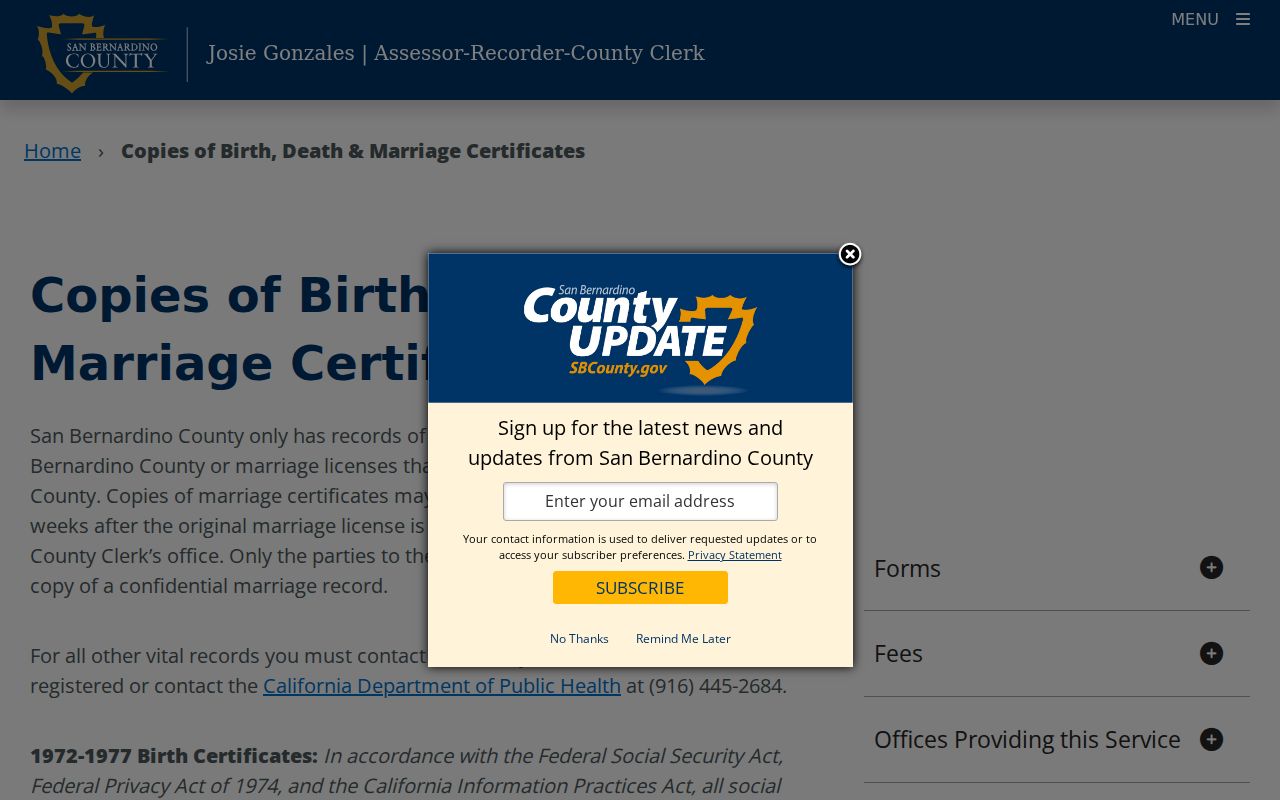
The captured page helps distinguish county birth, death, and marriage services before a requester selects a form or pays a copy fee.
Loma Linda Permit Records Online
City Building and Safety keeps local building, plumbing, electrical, mechanical, grading, demolition, plan-check, and inspection records. Current applications must use the Online Permit Portal. Account holders select the Apply tile, search under Plans for planning matters or Permits for building, fire, and public works matters, attach forms or plans, and submit. City instructions say staff generally need two to three business days to process a filing and apply fees.
Use the Loma Linda Online Permit Portal to review its current entry screen.
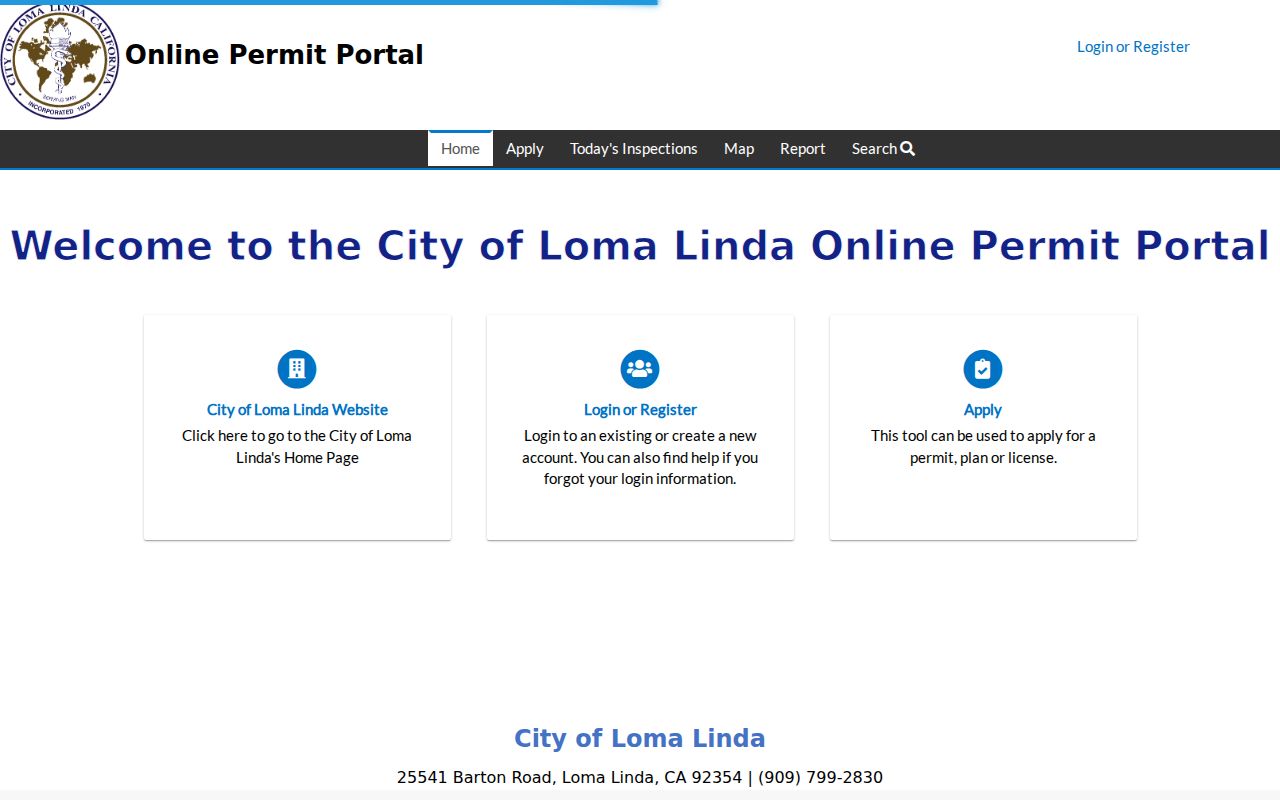
The portal separates plan and permit work from ARC's land records. If a permit is not visible, ask Community Development or use the city PRA route. ARC notes that recorded deeds rarely establish a building's age, and neither the Recorder nor county Historical Archives keeps municipal building permits.
Note: Confirm which agency had jurisdiction when the work occurred, especially for older sites near a city or county boundary.
Loma Linda Records Offices and Portals
The main public-records offices serving Loma Linda are in the city and county seat. Counter hours differ, and a single ARC office family handles several distinct record channels. Contact the named unit before traveling if an old file, certified copy, or appointment is needed.
Loma Linda City Hall
25541 Barton Road
Loma Linda, CA 92354
909-799-2800
Monday-Thursday, 7:00 a.m.-5:30 p.m.
ARC Recorder-Clerk
222 W. Hospitality Lane, 1st Floor
San Bernardino, CA 92415
909-387-8306
Posted hours: 8:00 a.m.-5:00 p.m.
ARC Assessor Services
222 W. Hospitality Lane
San Bernardino, CA 92415
909-387-8307
Parcel and assessment information
County Historical Archives
412 W. Hospitality Lane, 1st Floor
San Bernardino, CA 92408
909-387-1001
Closure notice posted during research; remote help available
This office map avoids a common local error. City Hall expressly directs police reports to the Sheriff's Department and vital certificates to ARC. A municipal request sent to the wrong custodian can add delay without changing the access rules.
Loma Linda Sheriff Records Search
Loma Linda contracts law enforcement to the San Bernardino County Sheriff's Department. The city therefore does not hold sheriff service records. County report requests go through NextRequest, while the Sheriff's Inmate Locator provides a separate public search for current jail data. Some reports may be limited to a victim or another specified person and can require proof of identity or relationship. The San Bernardino County request form is the documented route for county departments and sheriff records.
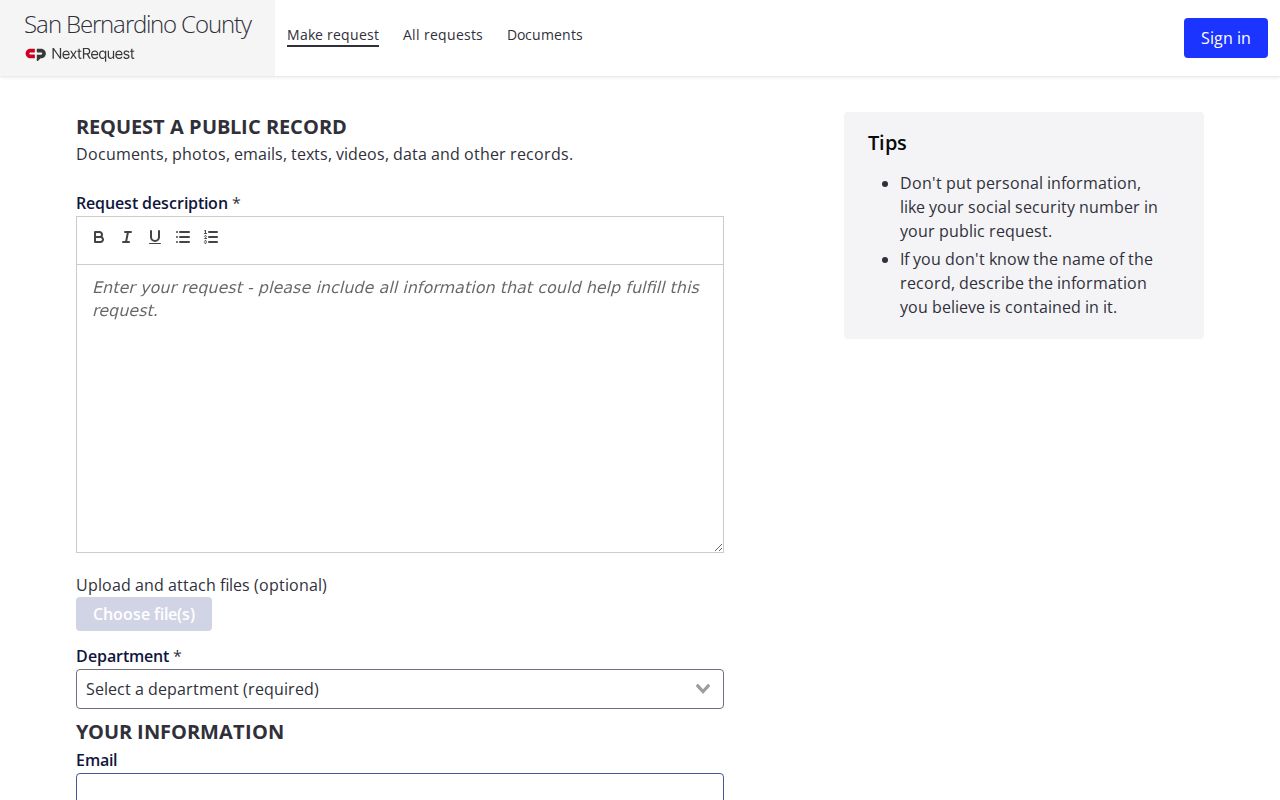
The request portal is the fallback for releasable reports that do not appear in a public lookup.
Loma Linda Inmate Locator Search
The direct county Inmate Locator accepts a ten-digit booking number or a name search using last name, first name, date of birth and gender. If birth date is unknown, the form permits approximate age and searches two years on either side.
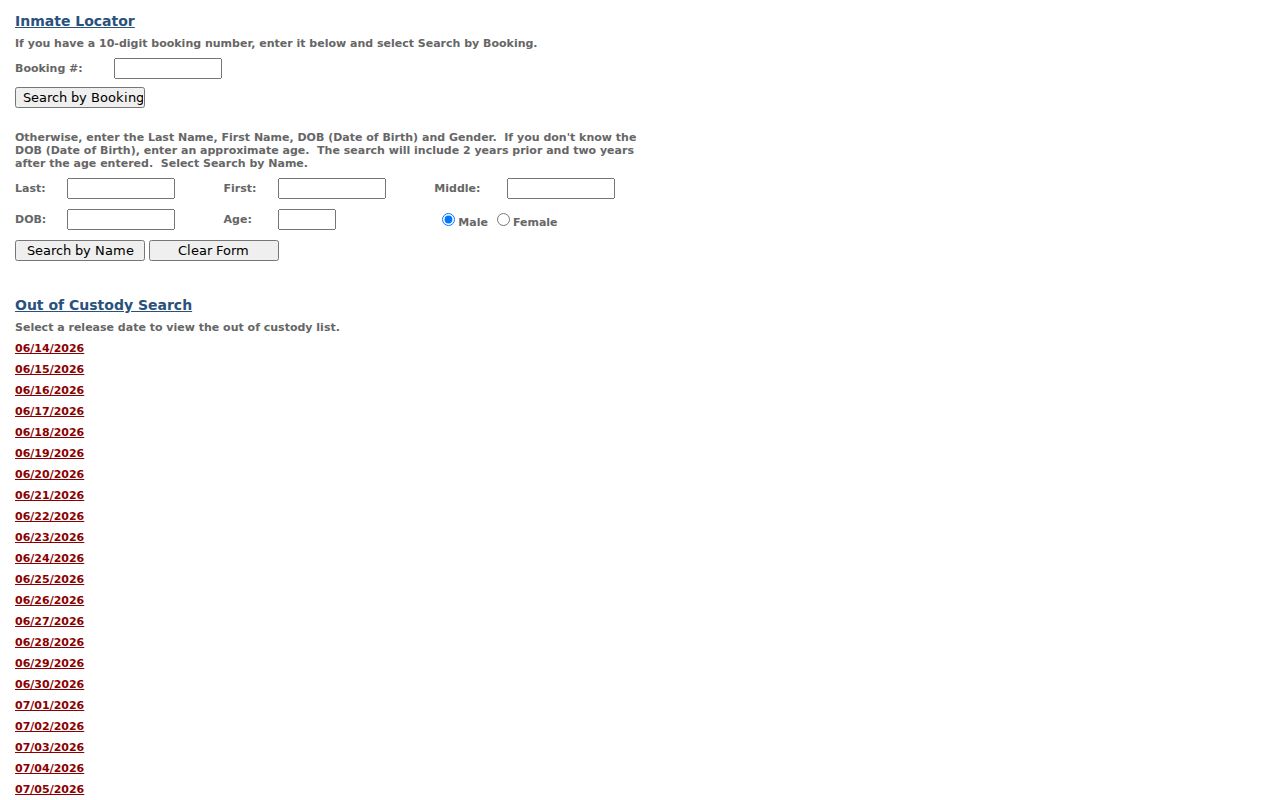
The booking form concerns current county custody and projected releases. It is not a substitute for a court docket or a sheriff report request.
Closed Loma Linda Records Under California Law
Open government has boundaries. California law withholds or limits juvenile matters, sealed and expunged cases, adoption files, confidential family-law documents, protected victim data, some investigations, confidential marriage copies, authorized vital copies, Social Security numbers, signatures, driver-license data, and certain voter fields. Safe at Home can replace an eligible participant's residential address with a substitute mailing address. Qualifying public officials may also have protected property addresses.
These limits follow the record, not the requester’s choice of portal. A CPRA filing cannot turn a confidential certificate, sealed court file, or restricted agency record into a public document. When an office redacts a page, the released portion may remain useful while protected facts stay hidden.
Use records lawfully. Public access supports family history, estate research, civic review, fraud checks, and personal safety. Never use a record to stalk, harass, threaten, or harm another person.
Request Loma Linda Public Records
The California Public Records Act, Government Code section 7920.000 and following, applies to agency records not governed by a more specific access law. Government Code section 7922.535 gives an agency ten days to determine whether it holds disclosable records responsive to a request. Unusual circumstances can support a fourteen-day extension. The determination is not a promise that all copies will arrive in ten days.
- Identify the custodian. Use City Hall for municipal files, ARC's set process for recorder or vital copies, the court clerk for case files, and county NextRequest for sheriff records.
- Check the correct index first. A document number, case number, address, parcel number, date range, or known party name can make the request far more precise.
- Describe identifiable records. State the subject, approximate dates, department, address, file type, and preferred delivery method without demanding that staff answer a new question.
- Submit through the office's form, portal, mail, or counter channel. Keep the confirmation and respond if staff seek clarification.
- Review the determination. If records are withheld, read the cited exemption, narrow an overly broad request when useful, and ask the agency to explain the available review path.
ARC's CPRA channel excludes items that already have statutory copy systems, including birth, death, and marriage certificates, assessor property products, and recorded-document copies. Its public-records request page explains that distinction and the direct-cost duplication rule.
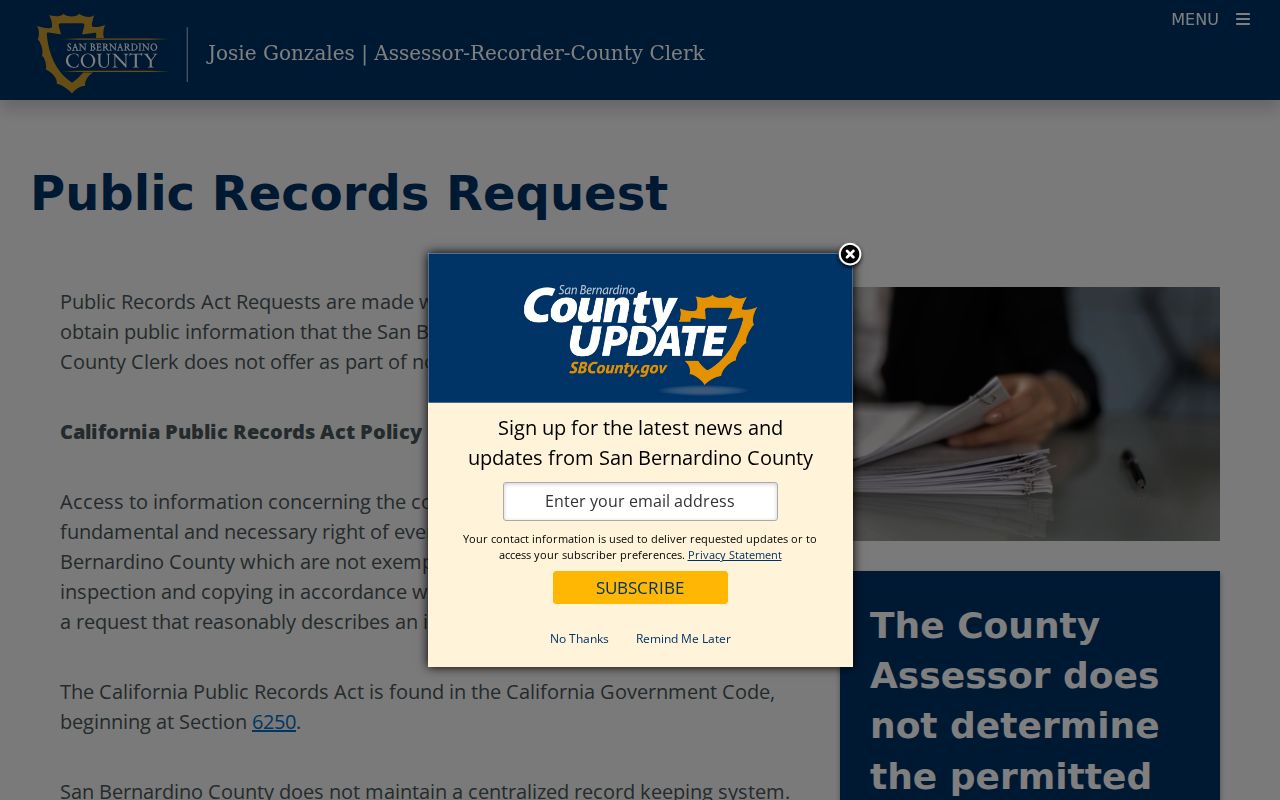
The captured ARC page shows why the correct copy process matters as much as the CPRA deadline.
Note: California agencies generally charge direct duplication costs under CPRA unless a separate law sets a special fee for the record.
Verify Loma Linda Liens Before Paying
San Bernardino County issued 2025 warnings about property-tax payment scams and misleading letters that sought payment for liens. A formal-looking letter is not proof that a debt is valid or that the sender represents the county. Check the party, document number, date, and document type in the official ARC index. Then contact the named county office through its official site before sending funds.
Deed-copy solicitations can also charge far more than the public custodian's stated copy price. Order a needed record from ARC. The State Controller likewise says there is no fee to claim California unclaimed property. For suspected real-estate fraud, the San Bernardino County District Attorney Real Estate Fraud Unit provides an official complaint channel.
A public index is most valuable here as a verification tool. Compare names and filing facts, obtain the actual document when needed, and do not rely on a private demand letter as the final word.